Key takeaways
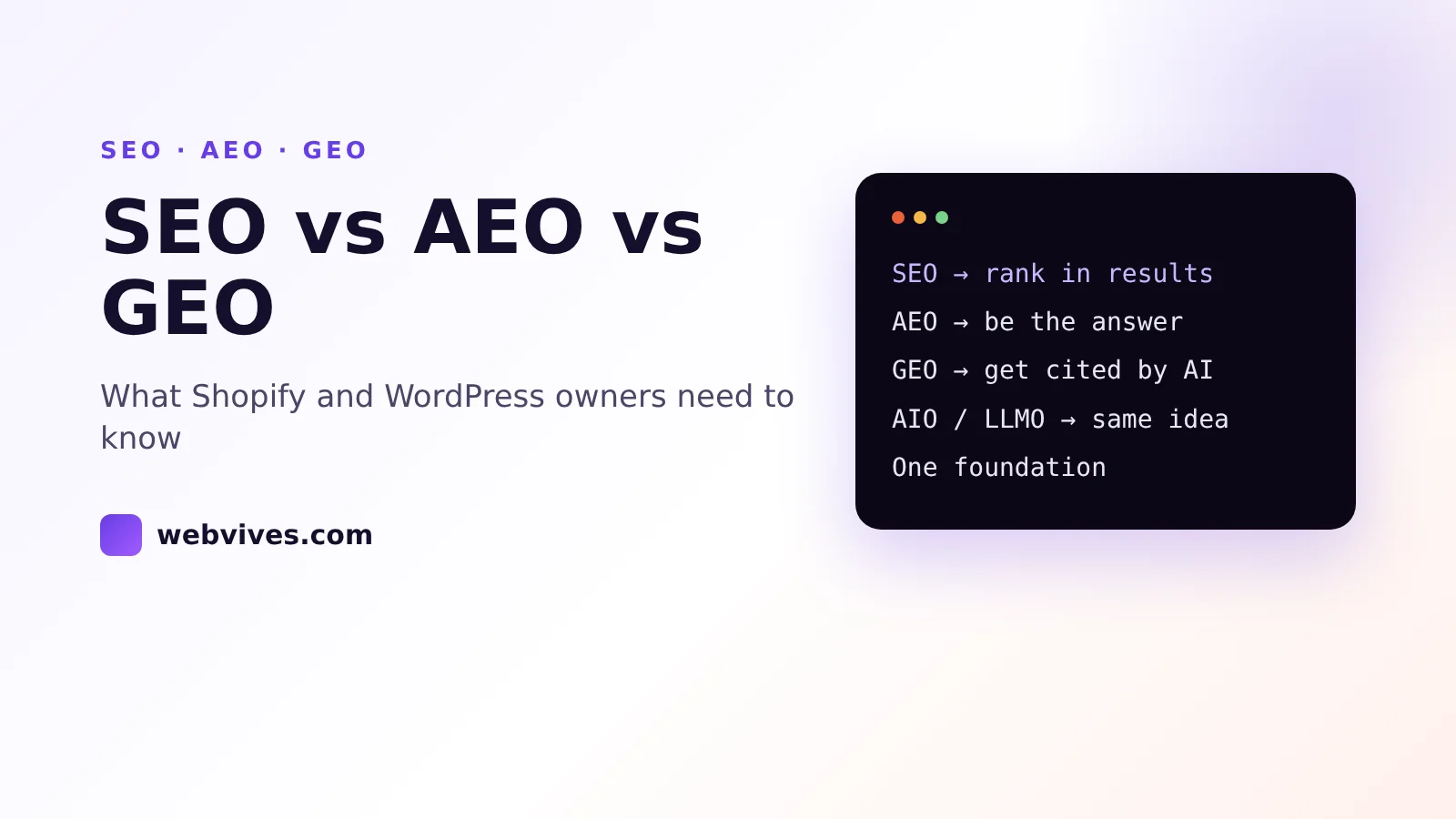
- SEO helps your pages rank in search results. AEO (answer engine optimization) helps your content become the direct answer. GEO (generative engine optimization) helps AI tools like ChatGPT and Google AI Overviews find, understand and cite you.
- AIO and LLMO are other names for the same idea: optimizing for AI-generated answers and large language models.
- They share one foundation. Google says there are no special optimizations needed for AI Overviews or AI Mode beyond normal SEO best practices.
- For Shopify and WordPress sites, the practical work is the same list: crawl access, indexing, clear answer-first pages, structured data, speed and consistent business details.
The short answer
SEO, AEO and GEO are not three separate strategies you need three agencies for. They are three angles on the same goal: being the source that search engines and AI assistants trust and show. Good SEO is still the base. AEO and GEO add a focus on clear answers, verifiable facts and being easy for AI tools to quote.
What each term means
| Term | Stands for | Goal | Where it shows |
|---|---|---|---|
| SEO | Search engine optimization | Rank pages in search results | Google, Bing results pages |
| AEO | Answer engine optimization | Become the direct answer to a question | Featured snippets, voice assistants, AI answers |
| GEO | Generative engine optimization | Be found, understood and cited by generative AI | ChatGPT search, Google AI Overviews and AI Mode, Copilot, Perplexity |
| AIO | AI optimization | A broad label for optimizing for AI search | All AI-driven search |
| LLMO | Large language model optimization | Make content easy for LLMs to read and reference | AI assistants and chatbots |
What Google actually says
Google’s guidance for site owners is clear: there are no additional requirements to appear in AI Overviews or AI Mode, and no special optimizations are necessary. You don’t need new machine-readable files, AI text files or special schema. A page has to be indexed and eligible to show a snippet in Search. In other words, solid SEO is the entry ticket to Google’s AI features.
Other AI assistants work differently. ChatGPT search, for example, relies on OpenAI’s own crawler, OAI-SearchBot, so blocking it in robots.txt keeps you out of those answers. That is why GEO adds a few checks on top of classic SEO.
What’s the same and what’s different
The shared foundation
- Pages that can be crawled and are indexed.
- Helpful, original content written for people.
- Clear structure: one topic per page, descriptive headings, internal links.
- Fast, mobile-friendly pages.
- Structured data that matches what is visible on the page.
What AEO and GEO add
- A direct, 40–60 word answer near the top of the page.
- First-hand proof: case studies, real numbers and named authors.
- Consistent business facts (name, services, prices, locations) across your site and profiles.
- Access for AI crawlers such as OAI-SearchBot in robots.txt.
- Tracking AI referrals in analytics so you can see what works.
What this means for Shopify stores
- Fix indexing and duplicate URLs from tags, filters and collection-path product links.
- Write product and collection content that answers shopper questions, not manufacturer copy.
- Complete product schema (price, availability, reviews where real).
- Check Shopify’s Agentic Storefronts settings and product data for AI shopping channels like ChatGPT. Our guide on getting Shopify products into ChatGPT covers the steps.
See our Shopify SEO and AI search optimization service.
What this means for WordPress sites
- Clean up thin tag, category, author and attachment pages.
- Turn service pages into clear answers: what you do, for whom, how much, how long, with proof.
- Use your SEO plugin’s schema and keep it accurate.
- Consider an llms.txt file as a low-cost extra. Our llms.txt guide explains how.
- Keep plugins lean so pages stay fast and easy to crawl.
See our WordPress SEO and AI search optimization service.

Frequently asked questions
What is the difference between SEO, AEO and GEO?
SEO aims to rank pages in search results, AEO aims to make your content the direct answer to a question, and GEO aims to get your content found and cited by generative AI tools such as ChatGPT and Google AI Overviews. They share the same technical and content foundation.
Do I need special optimization for Google AI Overviews?
No. Google says there are no additional requirements or special optimizations for AI Overviews or AI Mode. Pages must be indexed and eligible to show a snippet, so normal SEO best practices apply.
Are AIO and LLMO different from GEO?
Not really. AIO (AI optimization) and LLMO (large language model optimization) are other names for optimizing content so AI tools can find, understand and reference it.
Can anyone guarantee my business appears in ChatGPT answers?
No. Nobody controls which sources AI assistants choose. You can improve your chances by allowing AI crawlers, getting indexed, answering questions clearly and keeping your business details consistent.