Key takeaways
- Shopify itself starts at $39/month on Basic (or $29/month billed yearly). The plan is rarely the biggest cost.
- The real budget goes on design and development, apps and payment processing fees.
- A DIY store can launch for a few hundred dollars in year one; a professionally built starter store usually costs a few thousand; custom brand builds typically run $3,500–$15,000.
- Apps are the cost that creeps up quietly. Review them every few months and replace simple ones with theme code.
The short answer
Most people ask “how much is Shopify?” and see $39/month. That’s the plan, not the store. A real budget has five parts: the Shopify plan, payment fees, a theme, apps and the design and development work. Here’s what each one costs in 2026, and three example budgets so you can see where your store might land.
- DIY store: roughly $500–$1,500 in year one, plus your time.
- Professionally built starter store: roughly $2,500–$5,000 in year one, including the build.
- Custom brand store: roughly $8,000–$25,000 in year one, including the build, apps and ongoing support.
Payment processing fees come on top, because they depend on your sales.
1. Shopify plans
| Plan | Billed monthly | Billed yearly | Online card rate | Extra fee with 3rd-party payments |
|---|---|---|---|---|
| Basic | $39/month | $29/month | 2.9% + 30¢ | 2% |
| Grow | $105/month | $79/month | 2.7% + 30¢ | 1% |
| Advanced | $399/month | $299/month | 2.5% + 30¢ | 0.6% |
| Plus | From $2,300/month | n/a | 2.25% + 30¢ | 0.2% |
Which plan do you need? Most new stores start on Basic. Move to Grow when you need more staff accounts and better reporting, or when the lower card rate saves more than the higher plan costs. Advanced and Plus are for stores with high volume, complex international selling or B2B needs. Card rates differ outside the US, so check Shopify’s pricing page for your country.
2. Payment processing fees
This is the cost most people forget, and for a growing store it’s often bigger than the plan. With Shopify Payments you pay the card rate only. With a third-party payment provider you pay that provider’s rates plus Shopify’s extra fee, so Shopify Payments is usually the cheaper option where it’s available.
Example: a store selling $10,000 a month online on the Basic plan, with an average order of $50, pays about $290 + $60 = $350 a month in card fees (2.9% + 30¢ on 200 orders).
3. Theme
Shopify offers good free themes, including Horizon, which we use as a base on many projects. Premium themes from the Shopify Theme Store are a one-time purchase, usually a few hundred dollars. A fully custom theme is built as part of a development project.
Our advice: a premium theme is only worth it if it already does most of what you need. Paying for a premium theme and then customizing most of it often costs more than starting from a clean, fast free theme.
4. Apps
Apps add reviews, email marketing, subscriptions, upsells, search, B2B pricing, digital downloads and more. Many have free plans to start, then charge monthly as you grow. A typical small store spends somewhere between $0 and $150 a month on apps; established stores often spend $200–$500 a month or more.
App costs creep up quietly. Every few months, list your apps, check what each one costs and earns, and remove the ones you don’t use. Simple features like badges, tabs or size charts can often be built into your theme once, instead of paid for monthly. That also keeps your store faster.
5. Domain and email
A domain usually costs about $10–$20 a year. Shopify doesn’t include business email inboxes, so most brands use Google Workspace or Microsoft 365, billed per user per month.
6. Design and development
This is usually the biggest single cost, and the one that makes the most difference to sales. Your options:
- DIY: free in cash, expensive in time. Fine for testing an idea.
- Freelancer: often a few hundred to a few thousand dollars. Quality and availability vary a lot.
- Agency: usually from about $1,500 for a starter store to $15,000+ for custom brand builds, with a team, a process and support after launch.
For reference, WebVives starter stores begin at $1,499 (premium theme setup, products and payments, 2–3 weeks), custom stores at $3,500 (custom design and sections, 3–6 weeks), and Shopify Plus, headless or app development is quoted after a call. Every project includes 30 days of free support.
7. Ongoing support and growth
After launch, budget for updates, fixes and improvements. Some owners handle this themselves; others use a developer as needed or a monthly plan. Our Shopify care plans start at $299/month and include development hours, theme and app checks and checkout testing. Marketing (ads, email, content and SEO) is a separate budget and usually the one that decides how fast you grow.
Three example first-year budgets
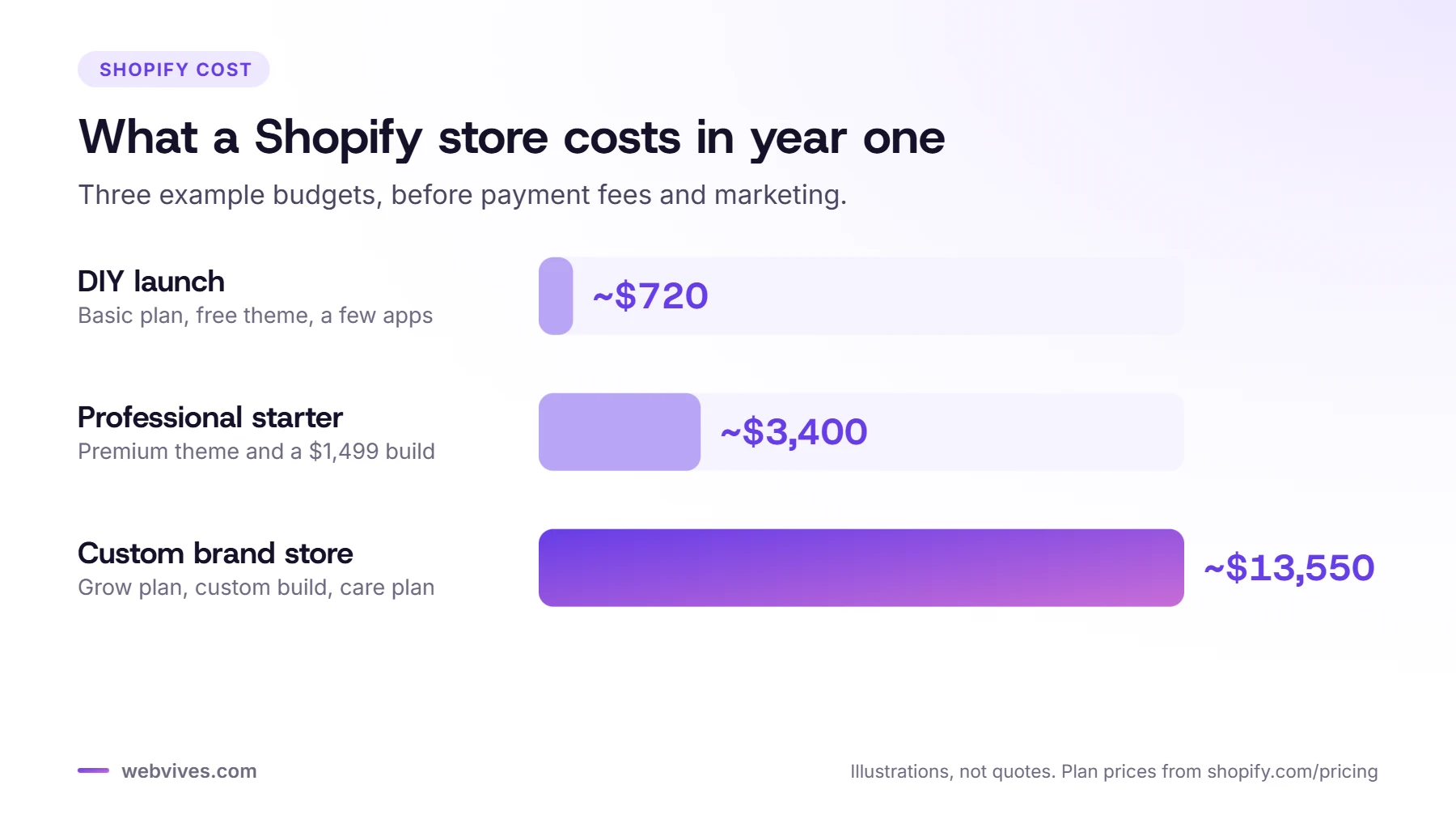
These are illustrations, not quotes. They leave out payment processing fees and marketing, because those depend on your sales.
| DIY launch | Professional starter | Custom brand store | |
|---|---|---|---|
| Shopify plan (billed yearly) | Basic: $348 | Basic: $348 | Grow: $948 |
| Theme | Free: $0 | Premium: ~$350 | Included in build |
| Apps | ~$30/month: $360 | ~$100/month: $1,200 | ~$250/month: $3,000 |
| Domain | ~$15 | ~$15 | ~$15 |
| Design and development | Your time | $1,499 | ~$6,000 |
| Ongoing support | Your time | As needed | Care plan: $3,588 |
| Approximate year one | ~$720 | ~$3,400 | ~$13,550 |
How to keep costs under control
- Pay yearly for your Shopify plan once you’re sure about the platform.
- Use Shopify Payments where available to avoid the extra third-party fee.
- Start on Basic and upgrade when the numbers say so, not before.
- Choose a fast theme that already fits, instead of heavily customizing a premium one.
- Replace simple apps with theme code, and review apps every quarter.
- Spend on what affects sales first: product pages, photos, speed and checkout.
The bottom line
Shopify is affordable to start and scales well, but the plan price is only the beginning. Budget for payment fees, apps and, most importantly, good design and development, because that’s what turns visitors into customers. If you’re not sure where your store fits, a 30-minute call is usually enough to give you a realistic number.
Frequently asked questions
How much does it cost to start a Shopify store?
A simple DIY store can start for a few hundred dollars in the first year: a Basic plan, a free theme, a domain and a few free or low-cost apps. A professionally built store usually starts at about $1,500, and custom brand builds typically cost $3,500–$15,000.
What are Shopify’s monthly fees in 2026?
At the time of writing, Shopify’s plans are Basic at $39/month, Grow at $105/month and Advanced at $399/month when billed monthly, or $29, $79 and $299 per month billed yearly. Shopify Plus starts at $2,300/month.
Does Shopify charge transaction fees?
If you use Shopify Payments, Shopify doesn’t add an extra transaction fee; you pay card processing rates, which in the US start at 2.9% + 30¢ online on Basic. If you use a third-party payment provider, Shopify adds a fee of 2% on Basic, 1% on Grow, 0.6% on Advanced and 0.2% on Plus.
Is it cheaper to build a Shopify store yourself?
It’s cheaper upfront. The trade-off is time, and the risk of a store that looks generic, loads slowly or doesn’t convert. Many brands start DIY and bring in a developer once sales justify it.
How much does a Shopify developer charge?
Rates vary widely by country and experience. For WebVives, starter stores begin at $1,499, custom stores at $3,500, and monthly care plans for Shopify at $299/month. Every project gets a fixed quote.
Sources and further reading
- Shopify pricing (Shopify)
- Choosing a Shopify plan (Shopify Help Center)