Key takeaways
- The European Accessibility Act has applied to e-commerce services since 28 June 2025.
- It can apply to businesses outside the EU when they sell to consumers in the EU.
- Microenterprises providing services (fewer than 10 staff and no more than €2 million turnover or balance sheet) are exempt.
- In practice, stores are assessed against WCAG 2.1 Level AA through the EN 301 549 standard. Penalties are set by each EU country.
The short answer
If you sell online to consumers in the European Union, your store probably needs to meet accessibility requirements under the European Accessibility Act (EAA). It has applied since 28 June 2025. The practical target is WCAG 2.1 Level AA: people must be able to browse, choose products and check out using a keyboard, a screen reader or zoom. Very small businesses may be exempt.
What the European Accessibility Act is
The EAA is an EU law (Directive (EU) 2019/882) that sets common accessibility requirements for key products and services, including computers, smartphones, banking, e-books, transport ticketing and e-commerce. Each EU country has written it into national law, so enforcement happens country by country.
Who it applies to
For online stores, the key question is whether you provide an e-commerce service to consumers in the EU:
- EU-based stores selling to consumers are in scope.
- Businesses outside the EU (for example in the US, UK or Canada) are generally in scope when they sell to EU consumers. This is how compliance guides read the law, so check with an adviser if this is you.
- Microenterprises that provide services are exempt. The Directive defines a microenterprise as a business with fewer than 10 employees and an annual turnover or balance sheet total of no more than €2 million. They’re still encouraged to comply.
- UK-only sellers: the EAA isn’t UK law, but the UK’s Equality Act 2010 already expects reasonable adjustments. Selling into the EU brings the EAA into play.
What standard you need to meet
The Directive describes accessibility outcomes rather than code-level rules. In practice, the European standard EN 301 549 is used to show conformance, and for websites it maps to WCAG 2.1 Level AA. WCAG 2.2, published in October 2023, adds a few more checks. Building to WCAG 2.2 AA covers both.
For an online store, that means things like:
- Every link, button, menu and form works with a keyboard, with a visible focus outline
- Product images have useful alt text
- Text and buttons have enough color contrast
- Forms have labels and clear error messages
- Sliders and videos don’t autoplay without a pause control
- Cart drawers, popups and filters can be used and closed with a keyboard
Information and accessibility statements
The EAA also asks service providers to explain how their service meets the accessibility requirements. Most stores do this with an accessibility statement page: what standard you aim for, known issues you’re fixing, and how customers can report a problem or get help another way.
Deadlines and penalties
The requirements have applied since 28 June 2025. Some services that rely on products already in use before that date have transition periods until 28 June 2030, but this rarely helps a typical online store. Penalties are set by each EU country and must be effective, proportionate and dissuasive, so they vary across the EU.
Your action plan
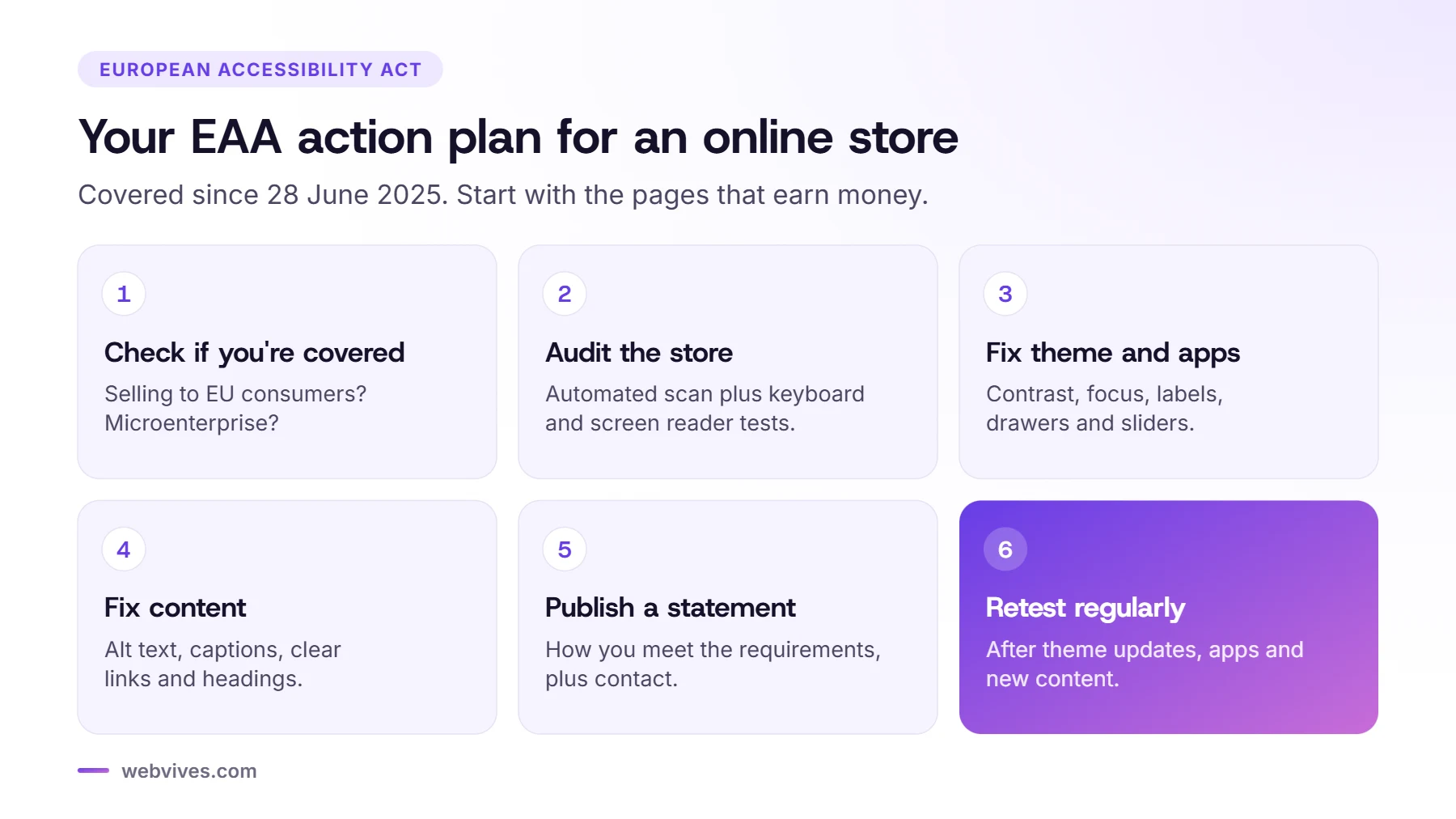
- Check whether you’re covered. Do you sell to EU consumers? Are you a microenterprise?
- Audit the store. Run an automated scan, then test with a keyboard and a screen reader. Automated tools catch only part of the problems.
- Fix the theme and apps. Start with the homepage, collection pages, product pages, cart and search. Ask app developers about the accessibility of their widgets.
- Fix your content. Alt text, video captions, clear link text and proper headings.
- Publish an accessibility statement with a contact method.
- Retest regularly, especially after theme updates, new apps and new campaigns.
On Shopify, the checkout is built and maintained by Shopify, so focus your effort on your theme, apps and content. On WordPress and WooCommerce, you’re responsible for the whole journey, including checkout.
A note on accessibility widgets
Some vendors sell overlay widgets as a quick way to comply. They don’t fix the underlying code, and the US Federal Trade Commission fined one vendor $1 million in 2025 over claims that its tool could make any website compliant. We explain why in our guide to accessibility overlays.
This article is general information, not legal advice. For advice on your situation, speak to a lawyer in the relevant country.
Sources and further reading
- Directive (EU) 2019/882 (European Accessibility Act) (EUR-Lex)
- European Accessibility Act (European Commission)
- A new era for inclusion begins: the EAA enters into force (AccessibleEU)
- What’s new in WCAG 2.2 (W3C WAI)
Frequently asked questions
When did the European Accessibility Act take effect?
The EAA’s requirements for products and services, including e-commerce, have applied since 28 June 2025.
Does the European Accessibility Act apply to non-EU businesses?
It can. Businesses outside the EU are generally in scope when they sell to consumers in the EU. Check your situation with a legal adviser.
Are small businesses exempt from the EAA?
Microenterprises that provide services are exempt: businesses with fewer than 10 employees and an annual turnover or balance sheet total of no more than €2 million.
What standard does the EAA require for websites?
In practice, conformance is shown with the European standard EN 301 549, which maps to WCAG 2.1 Level AA for web content.
Does Shopify make my store EAA compliant?
Shopify maintains its checkout, but your theme, apps and content are your responsibility. Audit and fix those, and publish an accessibility statement.